Pictures and credits
Every photograph and painting on this site, with its licence.
All pictures come from Wikimedia Commons, and each licence was checked on its file page on 20 November 2026. They are public domain, CC0, CC BY or CC BY-SA. Nothing here is licensed non-commercial or no-derivatives. The logo and favicon are our own simple designs. The covers and pages on the printables page are our own products.
 Pearly King of Harrow.jpg — Matt Brown, 2023, CC BY 2.0. The Pearly King of Harrow’s jacket, photographed in May 2023. Resized for the web and cropped; no other changes. Also cropped for the home page.
 Pearly King and Prince from Finsbury.jpg — Mark Kelly, 2006, CC BY 2.0. The Pearly King and Prince of Finsbury in Brighton, September 2006. Resized for the web; no other changes.
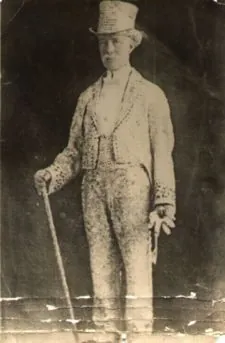 Henry Croft Pearly King.jpg — Unknown photographer, about 1900, Public domain. Henry Croft, the first pearly king, photographed around 1900. Resized for the web; no other changes.
 St Martin in the Fields, Henry Croft.jpg — AndyScott, 2019, CC BY-SA 4.0. A statue of Henry Croft, photographed at St Martin-in-the-Fields, London, in 2019. Resized for the web; no other changes. Shared here under the same licence.
 FMIB 38298 Cutting room, where blanks are cut from the raw shells.jpeg — Robert E. Coker, US Bureau of Fisheries, 1921, Public domain. A button-factory cutting room, where blanks were cut from raw river shells. From Coker’s 1921 report on freshwater mussels for the US Bureau of Fisheries. Resized for the web; no other changes.
 FMIB 38291 Tubular saws of different sizes, saw and spun fitted into the chuck, and shell from which blanks have been cut.jpeg — Robert E. Coker, US Bureau of Fisheries, 1921, Public domain. Tubular saws, and a shell with the blanks already cut out of it. From the same 1921 Bureau of Fisheries report. Resized for the web and cropped; no other changes.
 FMIB 38878 Button Factory, Muscatine, Iowa.jpeg — Hugh M. Smith, US Fish Commission, 1899, Public domain. A button factory in Muscatine, Iowa, photographed in 1899. Resized for the web; no other changes.
 FMIB 38872 Interior of Button Factory Sorting the buttons, sewing them on cards, and packing in boxes.jpeg — Hugh M. Smith, US Fish Commission, 1899, Public domain. Inside a button factory in 1899: sorting the buttons, sewing them on cards and packing them in boxes. Resized for the web; no other changes.
 Muscatine IA Mississippi Harvest Statue 1.jpg — MidwestMoss, 2026, CC BY-SA 4.0. “Mississippi Harvest”, a statue on the Muscatine riverfront honouring clamming and the pearl button industry. Resized for the web; no other changes. Shared here under the same licence.
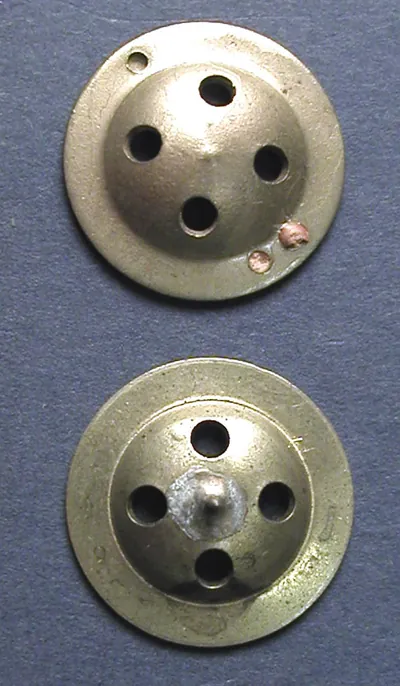 Compass, button (AM 2004.41.4-1).jpg — Auckland War Memorial Museum (object issued by the Royal Australian Air Force), CC BY 4.0. An escaper’s button compass from the Second World War: two ordinary-looking buttons that make a compass when one is balanced on the pin of the other. Auckland War Memorial Museum. Resized for the web; no other changes.
 Compass, button (AM 2004.41.4-3).jpg — Auckland War Memorial Museum (object issued by the Royal Australian Air Force), CC BY 4.0. The same pair of buttons beside a ruler. Each is not much bigger than a fingertip. Auckland War Memorial Museum. Resized for the web; no other changes.
 Elevator buttons, Heathrow Terminal 5, Hounslow, London, 2026-02-17.jpg — Cory Doctorow, 2026, CC BY-SA 4.0. A lift at Heathrow Terminal 5 in February 2026. The photographer noted that the close-door button (centre) was worn, while the open-door button was pristine. Resized for the web; no other changes. Shared here under the same licence.
 Identical door opening buttons in a lift, Groningen (2019).jpg — Donald Trung Quoc Don, 2019, CC BY-SA 4.0. A lift in Groningen, the Netherlands, in 2019, with two buttons for opening the door and none for closing it. Resized for the web; no other changes. Shared here under the same licence.
 Riding habit MET 1979.385.3ab F1.jpg — The Metropolitan Museum of Art, CC0. An American woman’s riding habit of about 1875. The Metropolitan Museum of Art. Resized for the web; no other changes.
 Jacques-Louis David - The Emperor Napoleon in His Study at the Tuileries - Google Art Project.jpg — Jacques-Louis David, Public domain. The Emperor Napoleon in His Study at the Tuileries, 1812, by Jacques-Louis David. National Gallery of Art, Washington. Resized for the web; no other changes.
 PSM V83 D033 The spread of tin disease in a sheet of tin.png — Popular Science Monthly, 1913, Public domain. “The spread of tin disease in a sheet of tin”, from Popular Science Monthly, 1913. Resized for the web; no other changes.
 Gustaf Cederström - Bringing Home the Body of King Karl XII of Sweden - Google Art Project.jpg — Gustaf Cederström, Public domain. Bringing Home the Body of King Karl XII of Sweden, 1884, by Gustaf Cederström. Nationalmuseum, Stockholm. Resized for the web; no other changes.
 Ornament or button for harness MET DP122479.jpg — The Metropolitan Museum of Art, CC0. An Assyrian shell ornament or button for a horse harness, about 9th–7th century BC. The Metropolitan Museum of Art. Resized for the web; no other changes.
 Button (France), 1750–99 (CH 68730619).jpg — Cooper Hewitt, Smithsonian Design Museum, Public domain. A French velvet-covered button, 1750–99, one of a set of seventeen made to match a man’s suit. Cooper Hewitt. Resized for the web and cropped; no other changes.
 Boulton&Wedgewood merfamily button f&b.jpg — Northeast Regional Button Association (NERBA), CC BY-SA 3.0. A steel button probably made in England in 1750–70: Matthew Boulton cut steels around a Josiah Wedgwood centre showing a family of merpeople. Front and back. Resized for the web; no other changes. Shared here under the same licence.
 Dorset crosswheel buttons.jpg — Abigail Seabrook, Moretta Designs, 2014, CC BY-SA 4.0. Dorset crosswheel buttons, made by hand with thread wrapped over a ring. Resized for the web; no other changes. Shared here under the same licence.
 Blandford cartwheel, red and white.jpg — Andy Dingley, 2014, CC BY-SA 3.0. A ‘Blandford cartwheel’, one of the many Dorset button designs. Resized for the web; no other changes. Shared here under the same licence.
 Bakelite Buttons 2007.068 (66948).jpg — Gregory Tobias, CC BY-SA 3.0. A set of 24 phenol-formaldehyde (Bakelite-type) buttons in different shapes and colours. Resized for the web; no other changes. Shared here under the same licence.
 White casein Australian Royal Airforce pre-1953 buttons.jpg — Tyranny Sue, 2010, CC BY-SA 3.0. White galalith (casein) buttons from Australian air force uniforms, made before 1953. Resized for the web; no other changes. Shared here under the same licence.
 Tagua nut buttons.jpg — AgaKu, 2015, CC BY-SA 4.0. Buttons made from tagua nut, shown from both sides. Resized for the web; no other changes. Shared here under the same licence.
 Box Full of Buttons For Sewing (42958527870).jpg — Dejan Krsmanovic, 2018, CC BY 2.0. A sewing box full of buttons. Resized for the web and cropped; no other changes. Also cropped for the advertising banner near the foot of the main pages.
 Industries of War - Buttons - GIRLS SEWING ON BUTTONS ON UNIFORMS - NARA - 31486225.jpg — Press Illustrating Service, 1918 (US National Archives), Public domain. “Girls sewing on buttons on uniforms”, a 1918 photograph from the US National Archives. Detail. Resized for the web and cropped; no other changes.
Useless, the eraser, is the ReallyByte mascot.